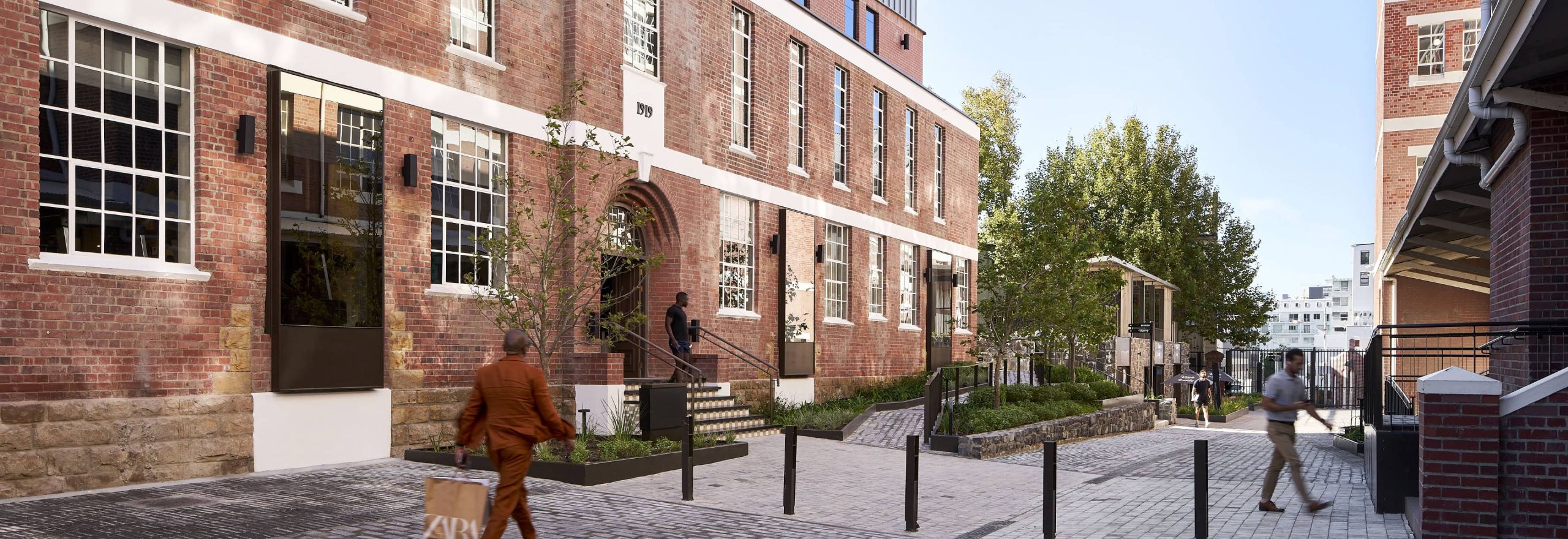
All Corobrik clay pavers are manufactured in accordance with the South African National Standard (SANS 1575:2007) for burnt clay paving units. The classification reflects the degree of uniformity in size and shape, and the strength the paver is produced to.
CLASSIFICATIONS
PA
Units that are selected or produced for their durability and for a high degree of uniformity in size and shape, and that have dimensions such that the ratio of work size length to work size width is approximately 1:1, 2:1 or 3:1.
Tolerances in work sizes (Length, Width, Thickness): Individual Unit: 5mm, 3mm, 3mm Average Dimensions of 32 units: 2.5mm, 1.5mm, 1.2mm
Average modulus of rupture (does not apply to paving units of length less than 80mm): Nominal modulus of rupture: 4 MPa Minimum individual modulus of rupture: 2.5 MPa
PB
Units that are selected or produced for their durability and for their uniformity in size and shape.
Tolerances in work sizes (Length, Width, Thickness): Individual Unit: 6mm, 4mm, 4mm Average Dimensions of 32 units: 3mm, 2mm, 2mm
Average modulus of rupture (does not apply to paving units of length less than 80mm): Nominal modulus of rupture: 3 MPa Minimum individual modulus of rupture: 2 MPa
CompleteTheFormToStartYourDownload
MOISTURE EXPANSION CATEGORIES CLAY FACE BRICKS
All burnt clay bricks demonstrate irreversible expansion after extended exposure to moisture. The extent of the expansion will vary according to brick type. Movement related to irreversible expansion can be accommodated through the insertion of vertical movement joints into horizontal lengths of walling.
SABS 0249 recommends design for potential movement due to moisture expansion, in mm/m:
Category I bricks– 0.5mm/m
Category II bricks – 0.5-1mm/m
Category III bricks – 1-2mm/m
THE BUILDING’S EXPOSURE ZONE
Southern Africa can be divided into four exposure zones, which are defined in SABS 0164 Part 2.
Zone 1 – Protected
All areas 30km or more inland from the coast.
Zone 2 – Moderate
The coastal belt extending up to 30km from the coastline, but excluding the spray zone.
Zone 3 – Severe
Sea spray zone. This includes areas at sea level on the east and north seaward sides of the Durban Bluff and other similarly exposed coastal headland areas.
The 15km coastal zone which extends from Mtunzini to the Mozambique border. This includes Richards Bay and St Lucia.
The coastal belt of Namibia.
Zone 4 – Extremely Severe
Area such as Walvis Bay, where the moisture from sea mist and high ground water tables, high soluble sulphates in the soil, and / or rapid temperature changes, combine to create the most severe exposure and weathering conditions in Southern Africa.
Industrial areas where high acid and or alkali discharges occur.